Author:Jia-Nan Fu, Franco Pirajno, Fan Yang, Espine Shivute, Yi-Zhan Sun, Ning Ai, Kun-Feng Qiu
Abstract
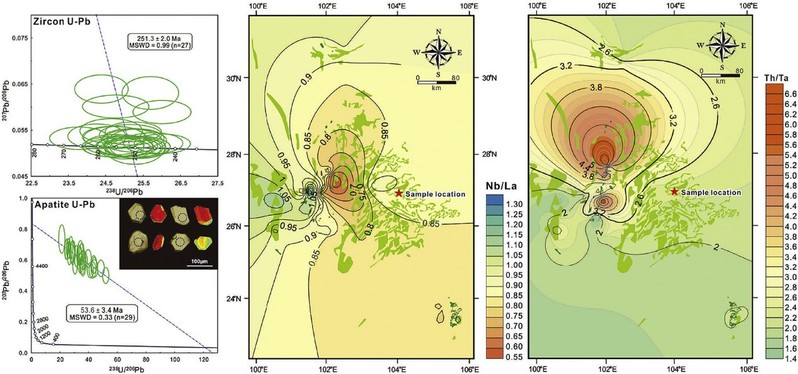
Radiogenic isotopic dating and Lu–Hf isotopic composition usinglaser ablation-inductivelycoupledplasma-massspectrometry(LA-ICP-MS)oftheWudebasalt in the Yunnan province from the Emeishan large igneous province (ELIP) yielded timing of formation and post-eruption tectonothermal event. Holistic lithogeochemistry andelements mappingofbasalticrockswerefurtherreevaluatedtoprovideinsightsintocrustal contamination and formation of the ELIP. A zircon U–Pb age of 251.3 ± 2.0 Ma ofthe Wude basalt recorded the youngest volcanic eruption event and isconsistent with the age span of 251–263 Ma for the emplacement of the ELIP. Such zircons have εHf(t)values ranging from –7.3 to +2.2, identical to those of magmatic zircons from the intrusive rocksof the ELIP, suggesting that crust-mantle interaction occurredduring magmatic emplacement, orcrust-mantlemixingexistedinthedeepsourceregionpriortodeepmelting.Theapatite U–Pb age at 53.6 ± 3.4 Ma records an early Eocene magmatic superimposition of aregional tectonothermal event, corresponding to the Indian–Eurasian plate collision. Negative Nb,Ta,TiandPanomaliesoftheEmeishanbasaltmayreflectcrustalcontamination.Theuneven Nb/La and Th/Ta values distribution throughout the ELIP supporteda mantle plume model origin.Therefore,theELIPwasformedasaresultofamantleplumewhichwaslater superimposedbyaregionaltectonothermaleventattributedtotheIndian–Eurasianplate collision during earlyEocene.
Keywords: Emeishan basalt; Zircon and apatite; Geochronology; Lu–Hf isotope; Early Eocene superposition; Indian–Eurasian plate collision
Graphical abstract