

Author: QiangWei, Chaonan Cui, Shifeng Dai
Abstract
The Wulantuga and Lincang germanium deposits in China are both giantcoal-hosted Ge deposits. It is a con- sensus that the enriched Ge inthe high-Ge coals is predominantly associated with the organics, butthe specific bonding sites for Ge still remain unclear. In thepresent study, conventional spectral analyses (13CNMR and KBr- FTIR) and the density functional theory (DFT)calculations were used to investigate the functional groups re-sponsible for Ge accumulation in the Wulantuga and Lincang deposits.
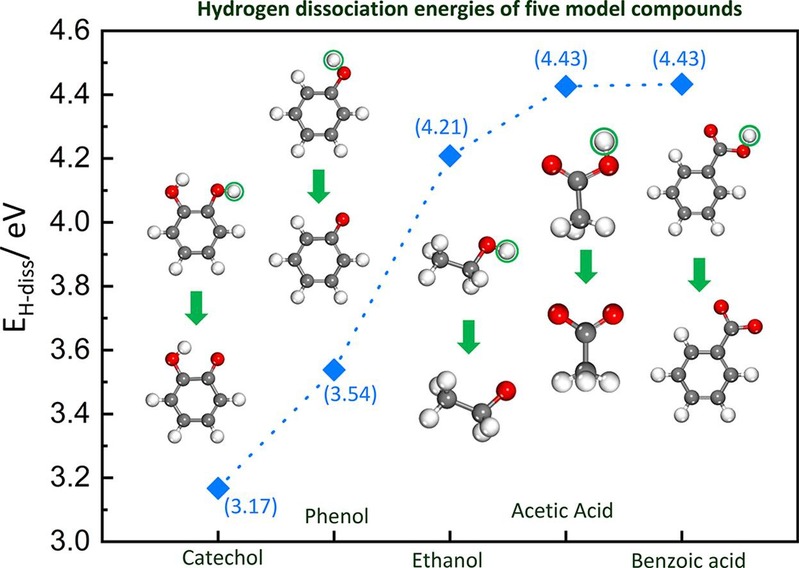
The analytical results of the semi-quantitative NMR and FTIR suggest thatthe phenolic hydroxyls suffered alteration by HCl-HF treatment andare most likely the bonding sites for Ge by comparing the structuresof the micronized and acid demineralized huminites from two high-Gecoals. Five acidic hydroxyl containing model compounds (catechol,phenol, ethanol, acetic acid, and benzoic acid) were selected toinvestigate the binding nature of Ge-O complexes, and the resultsindicate that phenolic hydroxyls have higher reactivity relative toother groups due to the easier exposure of oxygen by hydrogendissociation, which is the key step for the formation of Ge-Ocomplexes. Both the experiment and calculation results support thesignificance of phenolic hydroxyls for Ge fixation in the twodeposits, but the present study does not exclude the possiblecontribution of other O-containing groups.
Thisstudy facilitates understanding the mode of occurrence of Ge in thehigh-Ge coals and revealing the mechanism of the organic associationof Ge in the coal-hosted Ge ore deposits from the perspective of coalstructure.
Graphical abstract
Keywords: High-Gecoal; Coalstructure; Ge-Ocomplex; Phenolichydroxyl; Wulantuga; Lincang